

Yellow
Information · Cover · Excerpt · Reviews · Links
Information
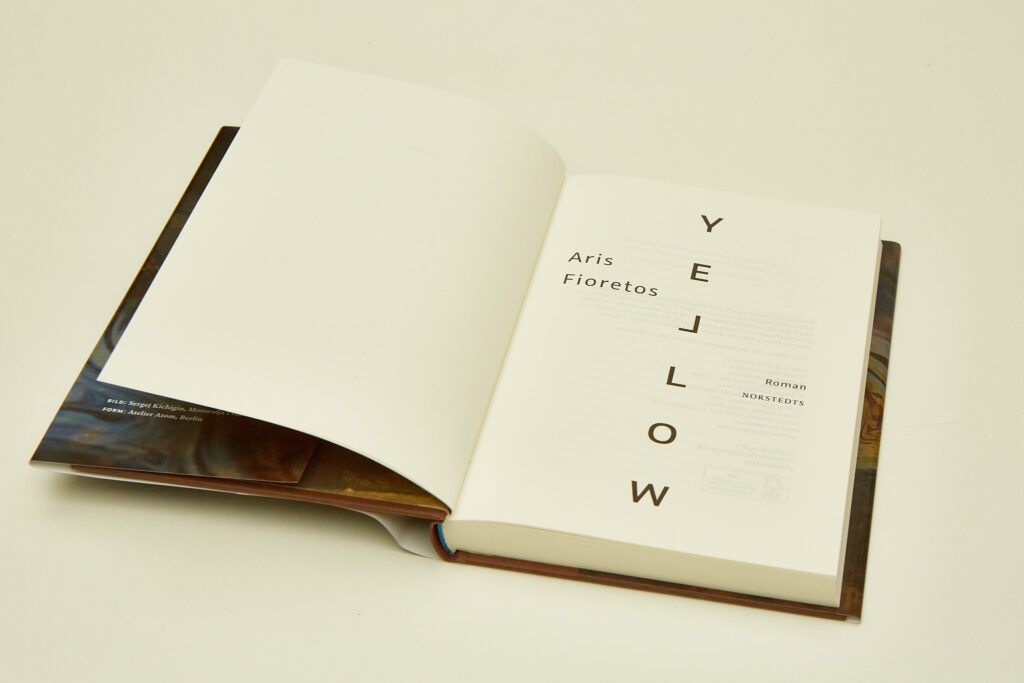
Novel · Stockholm: Norstedts, 2024, 240 pages · Design: Atelier Atom, Berlin · Cover photo: Sergei Kichigin · ISBN: 978-91-1-314747-5
Cover
They call her Yellow, rarely anything else. No one knows why. Except for the friends she arrived with in Europe. Now the Afghan refugee girl, who sometimes sees things that have not yet happened, is in trouble and needs help. But Aref lives far away, and Firooz … Where is Firooz?
Yellow races through a deserted German capital in summer. Moist air, oppressive heat. Quick-witted yet chaotic, with an amphibian’s gift for getaways, she must save what has become more important than a residence permit.
Yellow is a short novel about survival. And a long farewell to an eighteen-year-old’s lessons on belonging. It is also a novel about striving, and how the future doesn’t live up to its promises.
»In her mind’s eye, Yellow saw how the Romanian-German — slim, elegant, with hair like black steel wool — was about to bare his teeth. He was ten, twelve years older, perhaps more. She suspected that Ernest Schnell had sent him. And that soon, possibly as early as the next day, he would place a tin bucket in front of her. Then she would be forced to do something she did not want to under any circumstances.«
*
»She is very rebellious by nature.« (Ernest Schnell on Yellow)
*
Aris Fioretos is a writer. He lives and works in Stockholm and Greece.
»Fioretos has a unique ability to combine gripping, almost melodramatic life stories with a prose so sharp and lucid it makes the whole world seem new. « — Amanda Svensson in expressen on Nelly B’s Heart (2018)
»The only masterpiece of Swedish literature in this century.« — Agri Ismaïl in fokus on Atlas (2019)
»What matter-of-factness! What poetry!« — Åke Leijonhufvud in sydsvenskan on The Thin Gods (2022)
Excerpt
romanian-german
Yellow had never met the man before, yet she sensed he was Romanian-German. And that they would soon meet again. She even had a hunch about which papers he intended to buy: the ones featuring the pyramid and the sphinx in profile. Sometimes she experienced things that hadn’t happened yet. She had possessed the ability for as long as she could remember. No, not for as long as she could remember; since her grandmother had taken her to the glacial meltwater the summer before school started in Ghazni. No, again: should have started.
Her sinuses ached, as if before a storm.
further gifts
Among Yellow’s less uncommon gifts was the ability to walk without food. (Literally: eighty kilometers.) To smoke with the lit end turned inside the mouth, like soldiers in the trenches. To sit in lotus position, palms pressed against the ground, and lift herself up like a Buddha made of feathers. To mime both verses of a song that had crackled from a plastic baby monitor. (Later given away.) To be absorbed into her surroundings. And to write in mirror script.
gizeh
More on these gifts in due course. When her eyes welled up—as they now did in the convenience store—and the world dissolved into shifting shapes in a watery blur, the most important thing was to keep her composure. The future was seeping in. Just before the surface tension broke, the shapes darted about as if rocked by thunder, her thoughts scattering in a thousand directions. Some concerned what was to come—although she rarely understood which ones they were until later. As the present gave way, most of them flew out of her head. Up into space. Where they traveled through darkness and silence until space bent in on itself and they converged on the other side of an icy eternity. In the dimension—blacker than asphalt—where everything that could happen had already occurred.
While waiting for the world to denature, Yellow looked for the marker they used to label expired goods, but found only a blunt pencil. Carefully, she printed the name of the cigarette papers the Romanian-German would be asking for on a notepad. First an inverted G, then an i, followed by a z … The backward motion steadied her pulse—which was needed in order to handle the conversation she sensed would ensue. His gaze still wandered over the shelves behind her, with deliberate slowness.
integration course
Although the man acted like a customer, Yellow had no doubt whom he worked for. After the incident at the boss’s home during the first summer of the pandemic, she had quit her job as a courier from one night to the next. It didn’t take much to realize she and Firooz were no longer safe at Legion—the house by the canal that squatters still regarded as a »free state,« despite the pre-demolition contract being repeatedly extended. When a retired librarian who used to visit their neighbor offered her a room at her place, Yellow accepted without hesitation. Only those close to her knew she was now living with Valentina Pauli; together with the restrictions during the pandemic, that had provided sufficient protection. Last March, however, the corona era had officially ended, and now so had peace in a shop where the most exciting things that happened were customers stealing pizzas from the freezer or playing Fortnite on the computer by the window. She hoped the boss’s men hadn’t found Firooz yet. Her friend was made of weaker stuff.
Yellow’s years with Pauli had been secure, uneventful, instructive. Socially conscious and strong-willed, her hostess—herself a Volga German—insisted that Yellow take the integration course. The girl’s intelligence was obvious; resources should not be squandered. Besides, how else would she meet the requirements to stay? After bureaucratic hurdles that Pauli helped her overcome, Yellow signed up. One morning, with the scent of burning leaves wafting through the air, she walked to the school in a neighboring district. At the entrance, women in burqas waited alongside smoking African men who had pulled their FFP2 masks down beneath their chin. Firooz accompanied her on the first few days.
From time to time, participants were asked to talk about their lives—a task that proved more difficult than anticipated. Like Yellow, several refused; others burst into tears. Halfway through the first semester, the class was therefore asked to jot down »bullet points« that the person sitting next to them would use as stepping stones for speaking; according to their teacher, the capacity for empathy, too, was a virtue. Yellow liked the method so much she began to devise her own keywords. The German language provided necessary distance; suddenly, it became easier to process what had happened after parting ways with her grandmother. Since she found it hard to share a fair few experiences, however, she took the precaution of writing them down like the Renaissance genius the teacher had told them about: backwards.
One evening, while Yellow was being quizzed on vocabulary, Pauli explained that her own generation—the first born during the Cold War—was defined by its compass rose. Yellow understood the concepts of cold and war, but what was a compass rose? In response, her hostess placed one hand over her heart, smiling solemnly. This muscle had to bloom in every direction of the wind. Despite her commitment to helping the vulnerable, however, the edema she suffered from made her evade effort. If she saw the notebook where Yellow jotted down her points—as if to purge herself of the experiences—she would likely mistake the writing for Dari and not bother to fetch her reading glasses. Even so, Yellow hid the notebook in the inside pocket of her motorcycle jacket. It was an excessive precaution – still, the past years had taught her not to place unnecessary trust in well-intended people.
Now, her sense of security was gone. If the Romanian-German didn’t force her to come along, she had to warn Firooz. The Prima Donna, too, had found new accommodation, but was facing the threat of deportation; they ought to leave Berlin while it was still possible.
critical resource
Yellow doubted she’d have use for German in another country. The thought saddened her; she loved every new word the way others loved a song or a sunset. Or a dog, a cat. Words didn’t behave like pets, however. Sometimes as she hurried through a passage, the text would turn troublesome when the teacher urged her to go back to clarify the context. Suddenly, they meant something else. Instead of Mund, there was Mond; she laughed inwardly at having confused the moon with a mouth. Or she had read streben—to strive—only to realize the text was actually talking about dying: sterben.
For as long as Yellow could remember, people had claimed she was quick-witted but restless. According to Pauli—who would sigh theatrically whenever she saw the girl who had moved into her son’s old room scroll on her phone while doing homework—this eagerness bordered on tumult. Tumult? This time, a pencil pressed into Yellow’s solar plexus provided the explanation. She needed to rein in her energy. Actions were like the conjunctions meant to be filled in on the dotted lines between clauses: the key was to calmly and methodically stay fo-cus-ed on the context. With each syllable, Pauli pressed her red-capped pencil—the one used for crossword puzzles—a little further into Yellow’s abdomen.
The inability to focus on one thing at a time made writing in mirror-script a complicated matter. While pondering a stroke, Yellow might paint her nails in her latest favorite color or eat vegan muesli with Greek yogurt, causing the letters to bleed into each other in a pool of ink. Fortunately, perseverance was also among her gifts—albeit with a lowercase g. And one day, a first Leonardo word appeared in her notebook: elegant, hard to decipher, correct.
From then on, she captured—in bullet points—everything that raced through her mind but which she was unable to share with others. After reading an article about lithium—said not only to curb hyperactivity but also to be essential for manufacturing computer batteries—she viewed her backward words as a critical resource. It delighted her that the way they had to be deciphered resembled the mother tongue she had never learned to write; the past lived on in her hand’s movements.
At the thought of Dari, the moment’s surface tension broke.
discomfort
The turmoil when future events swirled through the present was reminiscent of how water striders—moving jerkily yet elegantly across the surface—would suddenly sink if a drop of washing-up liquid hit the film. They would kick bravely with thread-thin legs until, thanks to their dense body hair trapping a tiny layer of air, they managed to float back up. The storm inside Yellow’s head was akin to those kicks. Thrown off balance, her movements became jerky—as now, when she reached for the papers the Romanian-German had finally asked for. The booklet dropped onto the counter as if she had burned her fingers.
Discomfort was unavoidable, so Yellow held her breath to soften the tremors. After arriving in the city—in which, by now, she had lived as long as she had in her old homeland—she had tried a wide range of measures beyond filling her lungs with air. Eye drops. Face masks. Sunglasses even on gray days. (All on the recommendation of a Chilean woman at the gym she used to frequent.) A mountain of ibuprofen. (On her own initiative.) And a visit to an optometrist, in case of premature »macular degeneration.« (The optometrist’s term, but Pauli’s suggestion.) When meeting friends, she would sit with her feet resting on her thighs, diverting the blood to her stomach. Also, she often propped herself up with extra pillows at night, like a princess on a pea.
Before Yellow began summarizing her life in bullet points, none of these methods had truly helped. That pea, for instance, was not buried beneath layers of down and stuffing; instead, it resembled the disco ball at Alba Bar. Suspended beneath the crown of her head, it sowed malicious confusion in miniature format.
disco ball
The first time Yellow visited her boss’s bar, she hadn’t paid any attention to the décor. It was a cold January morning a few years earlier, the premises suffused in gloom. All she had noted before continuing up to the office on the upper floor was the way the counter gleamed in the light from the entrance—a frozen stream of bronze. On her next visit, a few evenings later, however, the disco ball was rotating slowly and steadily, waiting for guests to arrive. Spots the size of sequins drifted leisurely across chairs and tables; the sofas lining the walls appeared clad in wildcat fur. When the blurry shards were reflected in mirrors, they became unexpectedly sharp—like slivers of ice. Yellow imagined that this was what it looked like inside her head when she was in the throes of an episode—only more compact and on a smaller scale. Like the bar, her mind was dark and full of nooks and crannies, yet sometimes haunted by weightless flickering that made it difficult—nigh impossible—to get her bearings.
Had Yellow taken a moment to reflect, she would have laughed in helpless resignation. Without context, the points she jotted down would seem just as elusive to outsiders as those specks of light. Even if someone found the notebook in her jacket and managed to decipher the entries— for instance, using a pocket mirror—the points weren’t even arranged chronologically.
Yellow had learned to wait out the turmoil. Once the pain subsided, she could easily sleep until lunch; after that, events separated by time and space no longer blurred— once more, the world seemed intact. Was it with the dots as with those glints from the ball? If studied for long enough, would they form a shifting yet unified, forward-striving mosaic? Impossible to know. For now, the task was to endure the havoc.
Pages 7–13.
Reviews
»Aris Fioretos’s writing makes a cruel world shine.« — Jenny Aschenbrenner, Dagens Nyheter
»[Aris Fioretos] succeeds, in this complex tale, to unite raw, global contemporary politics with the sense that the world is mysterious and language astounding. […] Still, the text itself is not difficult to understand; on the contrary, reading Yellow is pure delight — the style is so fluid, just like the heroine herself. […] I read slowly, slowly. It’s as if my brain is swimming amidst ›shifting shapes in a watery blur,‹ in a state of protracted joy that intelligent, life-sustaining literature is still being written.« — Aase Berg, Borås-Tidningen and other papers
»This Year’s Best Swedish Novel. […] In Yellow, the reviled pop-culture trope of the ›manic pixie dream girl‹ finally finds redemption; the novel’s quirky heroine charms the pants off the reader while being allowed to be a complex, fully realized human being. […] At long last a novel that sweeps through the reader’s mind like a glorious storm, causing a surge that carries a message in a bottle all the way down to the heart’s desert island.« — Isabella Nilsson, Expressen
»I am in awe of Fioretos’s capacity for empathy. How can one live a normal life after having suffered under inhumane conditions for so long? […] As a portrait of contemporary life, the novel is trenchant: Yellow rides hotwired Voi scooters, smokes unfiltered Camels, jokes about Gigi Hadid. Her flight is described in almost unsettling detail — we learn how she, the family safe, had to swallow gold nuggets again and again. Yet her fate is handled with dignity; Fioretos describes dreadful aspects with great tact. […] It’s difficult to turn misery into literature. Perhaps that’s why so few books have been written about the 2015 refugee crisis — they tend to become either horror stories or watered-down imitations of literature about the world wars. Fioretos avoids both pitfalls. Yellow is a novel about loss, homelessness, and the need for roots. In that respect, it is not unlike W.G. Sebald’s masterful The Emigrants, but more contemporary in its sentiments and setting.« — Isabel Dahlgren, Kult Magasin
»[In Yellow,] pain and vulnerability meet intellectual reflection. We have seen it in Fioretos’s previous novels The Thin Gods (2022) and Mary (2015). It is a storytelling strategy that gives depth to reading because it never yields to sentimentality. […] Yellow survives. Her exile continues. The ending is hopeful yet dark. This paradox carries and characterizes the entire novel.« — Stefan Eklund, Svenska Dagbladet
»Fioretos writes with his customary sense for details. His novel is at once rigorously intellectual and feverishly sensitive. Perhaps this is the only way to depict the chaotic life trajectory of a refugee. This is, without a doubt, the most intense Swedish prose you will encounter this year. […] Fioretos guides us through the darkness of our contemporary era. The stress experienced by Yellow permeates the text, rendering it restless, anxious, hurried. Nor is there a lack of social critique—seen in reflections on what a refugee is permitted to express, and how tolerance is often conditional. […] I fell completely under the spell of [Yellow], having been drawn into its orbit. It is a powerful portrait, and of the way memories wash over the protagonist. For the hunted, there is no respite, no rest. […] As Fioretos himself noted in his book on Vladimir Nabokov a few years ago, the exiled Russian author posited three requirements for a good writer: the ability to tell a story, the ability to impart knowledge, and the ability to enchant. Fioretos certainly lives up to all three.« — Björn Kohlström, Bernur
»It is the successful combination of a suspense novel with psychological and experimental elements that makes Aris Fioretos’s Yellow worth reading. Its inventive and sensual language reflects the restless personality of its unprotected eighteen-year-old protagonist, as well as her chaotic thoughts shifting between her flight to Europe, life in Berlin, and her childhood in Afghanistan. The descriptions are both elegant and artful, zooming in on an array of minor details — such as how light strikes a disco ball. The writing is fleshly and visceral, featuring numerous bodily reactions, which creates a distinctive style. Yellow combines a powerful story of flight with poignant poetic language exploring trauma, vulnerability, and intuition.« — Thomas Rasmundsson, Bibliotekstjänst
»[Fioretos’s] protagonist, Yellow, possesses a number of intriguing traits that make her an ideal narrator. She has a certain capacity to see into the future, she can write backwards. She is also an energetic, rather difficult person—useful qualities when one must manage the journey from Afghanistan all the way to Europe and the German capital. And, subsequently, to a life as an undocumented person, left at the mercy of work in the shadows. […] In its quietly matter-of-fact way, [Yellow] brings to life an existence defined by loss. [This] is a novel constructed with remarkable intelligence. […] I am taken in by Fioretos’s stylistic dexterity. There is a coolness in the text—some might call it detachment—that lends it credibility.« — Ulrika Stahre, Aftonbladet
»I don’t know how Aris Fioretos manages to bring Yellow to life, but the novel holds up all the way through. The language is a living, breathing thing, making its way from Yellow’s chaotic mind out into the broken world. It blends visual impressions with analysis, rage with empathy, and a grandmother’s worldly wisdom with rebellion and vulnerability. Everyone needs to read this novel.« — Katarina Wikars, Kulturnytt
»Yellow is a tough-yet-tender teenage refugee with ADHD and a troublesome — albeit useful — ability to catch fleeting glimpses of the future in sudden, lightning-fast visions. Her sidekick is a male sex worker known as ›the Prima Donna,‹ who finds himself pursued by ›suitors.‹ Upon arriving in Germany, they fall into the clutches of a dysfunctional family business that deals drugs and organizes betting on destructive ›challenges‹ on the Darknet. A spectacular final showdown awaits when they attempt to break free. […] The novel’s greatest merit is in the realistic passages depicting the hardships and vulnerability of refugee life, and in Fioretos’s self-reflective prose — which is anything but formulaic and repeatedly triumphs in its portrayal of a consciousness caught between a dark past and a menacing future.« — Johan Wilhelmsson, Sydsvenskan
Links
»Vad vi riskerar om vi förlorar vår känsla för andras förluster«, Interview Norstedts (in Swedish) · »Aris Fioretos om flyktingskap, hem och tillhörighet«, Interview Förmiddag i P1 (in Swedish)