The World’s Shifting Navel
18.XI.25
I haven’t thought about it before – at least not in a focused, active way – but the important locations in my novels are not places to be found on a map. They exist in the world, albeit more in the realm of the imagination, though neither globes nor guidebooks would be of much help. Stockholm, Berlin, Dresden … Smyrna, Athens … New York, even London and Warsaw … Such places, not insignificant in their respective contexts, can of course be located. Even »Ano Potamiá«, »Balslöv,« or what the narrator in a later novel calls »Alaska« may be found by anyone who knows the correct GPS coordinates. I visited »Ano Potamiá« myself, for example, a couple of days before Christmas 2008, together with the real-life model for the book’s hero – out of an elusive sense of reverence, I suspect. The place turned out to be a mountainside a 45-minute drive north of Serres, not far from the Bulgarian border, where there has likely never been a village. »Balslöv,« which appeared in the same novel, borrowed features from two communities with similar names in northeastern Skåne, which as a child I knew like the back of my hand. And »Alaska,« this North Pole of solitude, has on one occasion been a solitary confinement cell on a nameless Greek prison island, and on another a snowdrift in a park in northeastern Philadelphia found with the help of Google Earth.
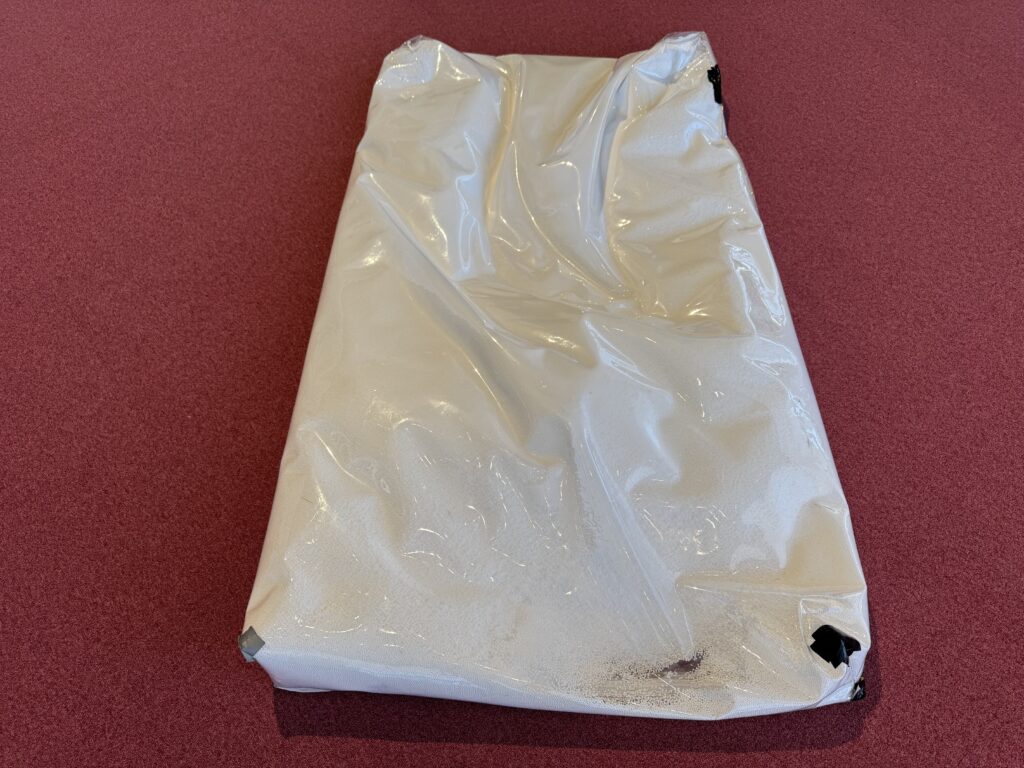
The books’ decisive locations, however, lack such cartographic clarity. They are not communities – backwaters, provincial boltholes, global metropolises – so much as psychogeographical places. If they were to have names, they might be The Bathtub, The Bicycle Saddle, The Water’s Edge. Or The Scrap Yard, The Concert Hall, Minus Two. Or why not The Mattress, as in the novel that is finally nearing completion? Like Alaska, The Mattress even changes character. The first time it is mentioned, it consists of a cushion at a Turkish detention center, covered in a striped fabric with thin and thicker lines that remind the protagonist of a sheet of music, the many stains on which (gasoline? urine?) resemble notes of pain. The second time, the mattress is newly purchased and wrapped in plastic, and the protagonist falls asleep on it after getting drunk for the first time in her young life.
People smarter than me may, if they can be bothered, investigate the secret status of these and other locations. For the first time, I am struck by the suspicion that they offer contemplation, and often repose – as if they were blank pages to be filled with orienting words. None of them are safe by any means; some instill panic and even induce dizziness or nausea, but they usually provide a central point from which a fictional character seeks to understand his or her situation. As if they were the shifting navel of the world.
Image: Lygia Clark, Grande colchão (Large Mattress), 1960s